

Global Health Seminar
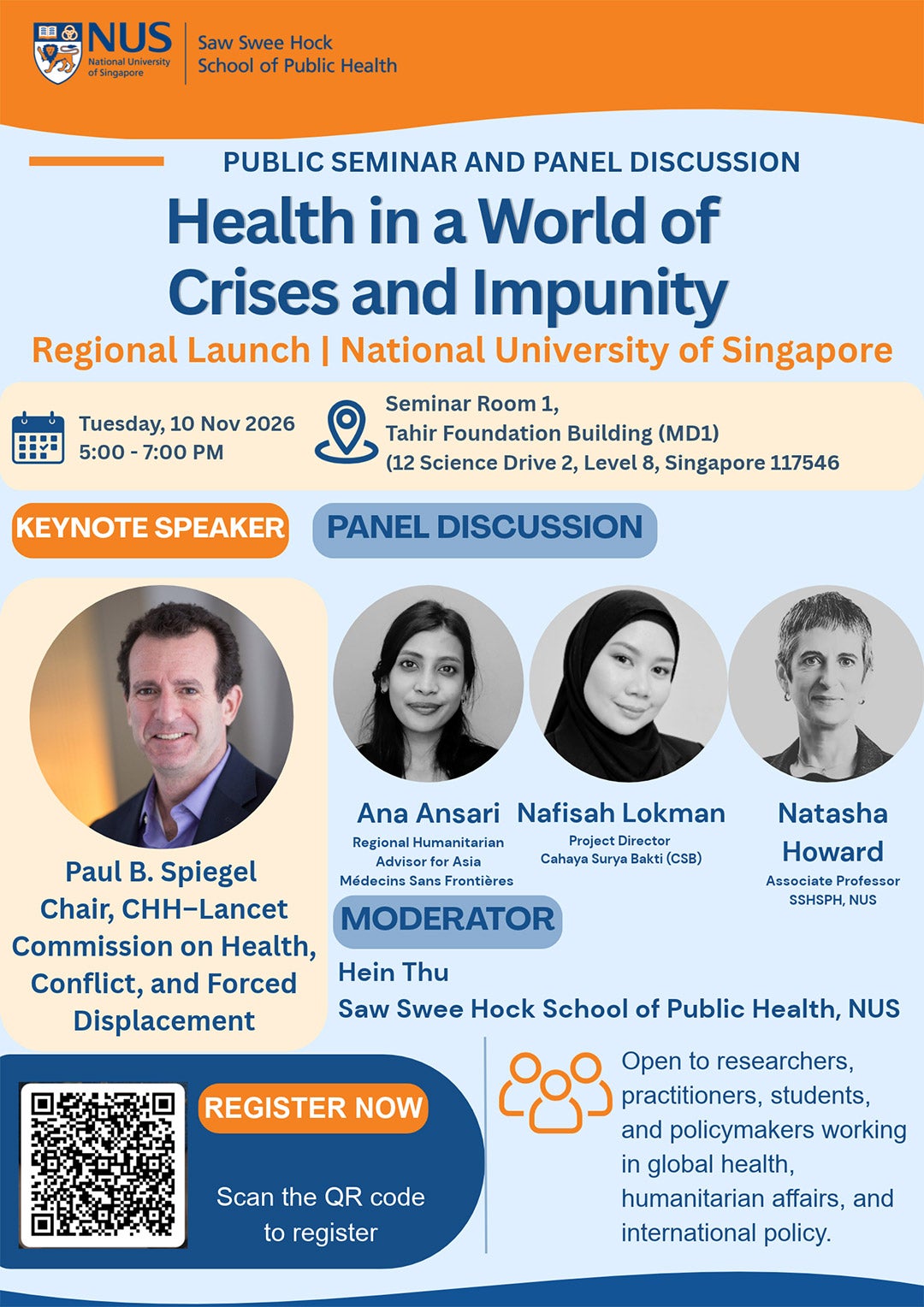
Health in a World of Crises and Impunity
Regional Launch of the CHH–Lancet Commission Report
An estimated 239 million people will need humanitarian assistance in 2026, yet only 87 million are expected to receive it. Against a backdrop of escalating conflicts, growing displacement, shrinking resources and increasing impunity, the humanitarian system faces mounting challenges in protecting the health and rights of people affected by crises.
The landmark report of the Johns Hopkins Center for Humanitarian Health–Lancet Commission on Health, Conflict, and Forced Displacement, chaired by Professor Paul B. Spiegel, calls for a fundamental transformation of the humanitarian system. Its recommendations include shifting power towards local actors and affected communities, strengthening accountability for violations of international humanitarian law, reforming humanitarian financing, and upholding the right to health for all people affected by conflict and displacement.
Following its global launch in Geneva in May 2026 and subsequent regional engagements across Africa, Asia, the Middle East, Asia, and Latin America, this Singapore launch will present the Commission’s key findings and explore their implications for humanitarian health policy, practice and partnerships in the Asia-Pacific region.
The event will feature a presentation by Professor Spiegel, followed by a panel discussion bringing together perspectives on the challenges and opportunities for advancing more equitable, accountable, and effective humanitarian health responses.
The seminar welcomes researchers, practitioners, policymakers, students and others interested in global health, humanitarian affairs and international policy.
Date:
10 November 2026, Tuesday
Time:
5.00pm – 7.00pm SGT
Venue:
Seminar Room 1, NUS Tahir Foundation Building (MD1), Level 8, 12 Science Drive 2, Singapore 117546
CME and CPE points will be awarded pending approval.
Speakers

Director, Johns Hopkins Center for Humanitarian Health
Distinguished Professor of the Practice, Johns Hopkins Bloomberg School of Public Health
Chair, CHH–Lancet Commission on Health, Conflict, and Forced Displacement
Dr. Spiegel is a Canadian physician and epidemiologist with over 30 years of experience in humanitarian health. He is the Director of the Johns Hopkins Center for Humanitarian Health and Distinguished Professor of the Practice in the Department of International Health at the Johns Hopkins Bloomberg School of Public Health.
He chairs the CHH-Lancet Commission on Health, Conflict, and Forced Displacement, whose report, Health in a World of Crises and Impunity, was published in The Lancet in May 2026 and launched in Geneva with regional events across four continents. The report calls for a fundamental transformation of the humanitarian system, centered on shifting power to affected communities, ending impunity for attacks on civilians and health care, financing based on need rather than politics, and upholding the right to health.
Previously, Dr. Spiegel served as Deputy Director of Program Support and Management and Chief of Public Health at UNHCR. He also worked as a Medical Epidemiologist at the U.S. Centers for Disease Control and Prevention, and in field operations with Médecins Sans Frontières and Médecins du Monde. His work has spanned Africa, Asia, the Middle East, and Europe.
He has authored over 200 publications on humanitarian health, migration, and human rights. He serves as Associate Editor for the journal Conflict and Health and is on the editorial board of the Journal on Migration and Human Security. He was the inaugural Chair of the Funding Committee for Research for Health in Humanitarian Crises (R2HC) and served on the Lancet Commissions on Syria and on Migration and Health.
He co-chairs Lancet Migration and serves on the Board of Directors of the International Alliance for Diabetes Action. Dr. Spiegel is at the forefront of global efforts to shape research and policy on climate change, conflict, forced migration, and health.

Medicine Sans Frontieres MSF Regional Humanitarian Advisor for Asia
Ana Ansari is MSF’s Regional Humanitarian Advisor for Asia, and the HRT’s regional representative. She focuses on humanitarian policy, crisis response, conflict-related humanitarian issues, and engagement with governments, international organizations, and other regional stakeholders in Asia Pacific, with a focus on Myanmar, Bangladesh and Afghanistan. Prior to her current role, Ana worked extensively in humanitarian representation and advocacy, contributing to discussions on humanitarian access, protection of civilians, and the delivery of impartial medical assistance in complex emergencies.

Project Director at Cahaya Surya Bakti (CSB)
Nafisah Lokman holds a Master of Arts in Southeast Asian Studies and a Bachelor of Arts from the University of Malaya. Her postgraduate research examined Humanitarian Assistance Mechanisms for Refugees in Malaysia: The Role of State and Non-State Actors, exploring the roles of state and non-state actors in responding to refugee needs and shaping humanitarian assistance.
With over six years of experience in the humanitarian sector, Nafisah serves as Project Director at Cahaya Surya Bakti (CSB), leading humanitarian and community-based initiatives supporting refugees and asylum seekers, particularly Rohingya communities, in Johor, Malaysia. Her work spans refugee protection, child protection, gender-based violence prevention, case management, and community empowerment, with a focus on addressing barriers to essential services and protection faced by displaced populations. Through her frontline experience, she brings practical perspectives on the intersection of forced displacement, vulnerability, and access to essential services, as well as the importance of locally led, community-centred humanitarian responses that uphold the dignity, rights, and well-being of affected populations.
Associate Professor, SSHSPH
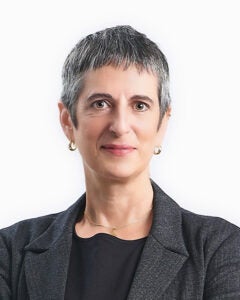
Natasha Howard is an interdisciplinary health policy and systems researcher focusing on infectious disease control in Asia and health system strengthening during protracted crises, fragility, and displacement. She holds a primary affiliation with the NUS Saw Swee Hock School of Public Health and a joint affiliation with the London School of Hygiene & Tropical Medicine. Her research expertise spans global health/One Health, Asian health systems in low- and middle-income countries, and mixed, qualitative, and participatory methodologies. In addition to her research, she directs the Doctor of Public Health (DrPH) programme at NUS and has extensive experience in postgraduate teaching, textbook editing, and mentoring students and health professionals.