

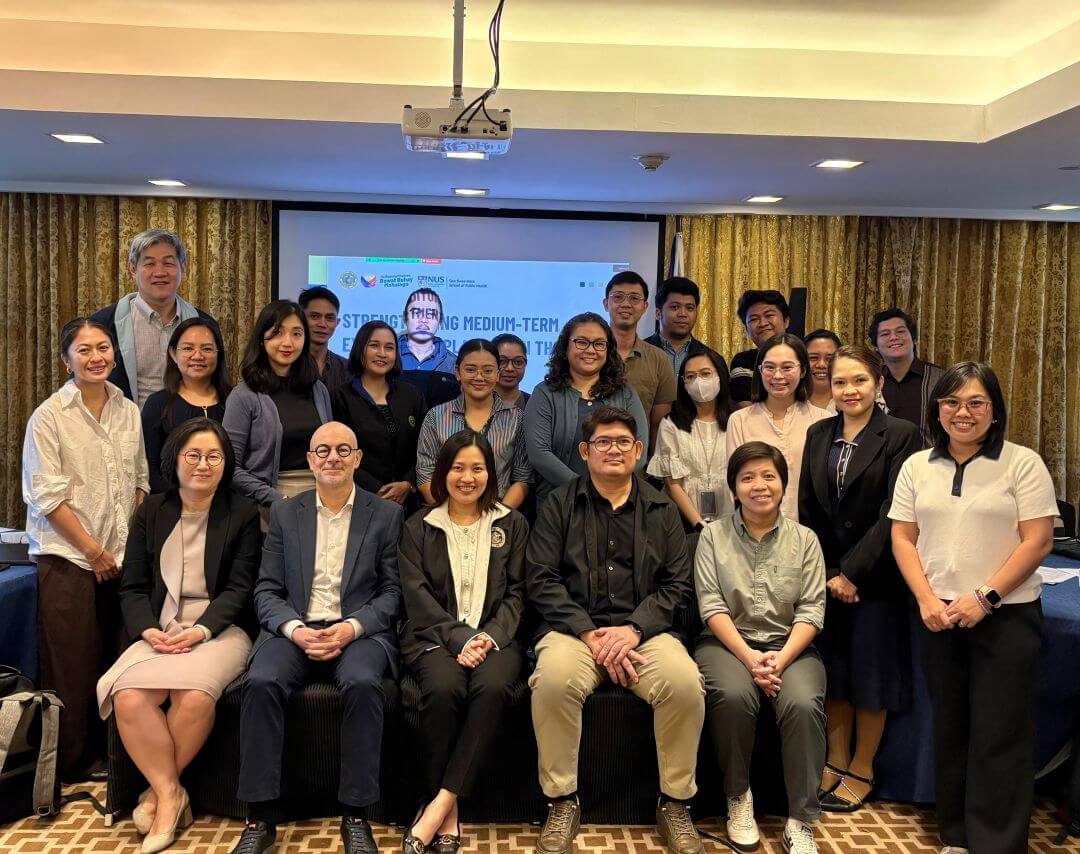
The NUS Philippines Partnership Programme organized a capacity-building workshop on Strengthening Medium-Term Expenditure Planning (MTEP) for key units of the Philippine Department of Health (DOH) and the Philippine Health Insurance Corporation (PhilHealth) on October 26–27, 2026.
MTEP serves as a forward-looking framework for determining the medium-term resource requirements of the DOH and PhilHealth in support of priority health programmes, activities, and projects. It helps align health sector priorities with projected financing requirements and available fiscal space.
The two-day workshop brought together technical experts and government partners to share lessons from international country experiences and previous MTEP cycles, and to identify opportunities to improve the MTEP development process and toolkit.
Day 1: Understanding MTEP and learning from country experiences
The first day opened with remarks from Dr. Harvy Joy Liwanag, Programme Director of the NUS Philippines Partnership Programme; DOH Undersecretary Lorra Sayson; and Dr. Yu Lee Park of the World Health Organization (WHO) Philippines Country Office.
To provide an overview of the MTEP process and establish a shared understanding among participants, Ms. Joanna Marie Lim of the DOH Health Policy Development and Planning Bureau (HPDPB) shared insights and reflections from previous MTEP outputs.
Ms. Kezia Lorraine Rosario of the DOH Disease Prevention and Control Bureau then presented an example of MTEP development from the perspective of a DOH programme manager, drawing on her experience with the National Tuberculosis Control Program.
Dr. Lluis Vinyals Torres of the WHO Western Pacific Regional Office (WPRO) shared examples from country experiences in medium-term health expenditure planning and highlighted key insights on how MTEP can help the DOH navigate its fiscal space.
The presentations concluded with Ms. Loraine Gallevo of the United States Agency for International Development (USAID) ProtectHealth, who synthesized recommendations from previous USAID technical assistance on MTEP.
Building on these presentations, participants worked together to develop a framework for a functioning MTEP through facilitated group discussions. The sessions were led by Dr. Liwanag, Dr. Park, and Dr. Piya Hanvoravongchai, Associate Professor at the NUS Saw Swee Hock School of Public Health (NUS-SSHSPH), together with Ms. Vanessa Siy Van and Mr. Vicente Alberto Puyat, Research Associates of the NUS Philippines Partnership Programme, and Dr. Denese De Guzman of WHO-WPRO.
Day 2: Applying the framework and identifying next steps
On the second day, Mr. Puyat and Ms. Lim facilitated a hands-on session in which participants applied the newly developed MTEP framework to practical case scenarios for expenditure projections.
Meanwhile, Ms. Kaycee Manuel, Programme Officer of the NUS Philippines Partnership Programme, facilitated a plenary discussion among DOH units to review and identify potential revisions to existing MTEP standards and practices prescribed by the DOH HPDPB.
The workshop concluded with the development of a roadmap for cascading the workshop’s key learnings to DOH programme managers, alongside discussions on opportunities for continued technical assistance from the NUS Philippines Partnership Programme.
In her closing remarks, DOH Assistant Secretary Razel Nikka Hao emphasized the importance of transforming established ways of working to ensure that planning processes translate into meaningful impact.
Through collaborative learning and practical discussions, the workshop sought to strengthen DOH participants’ capacity to take ownership of their MTEPs, better integrate them into the budgeting process, and use them as tools for strategic planning and decision-making.
The NUS Philippines Partnership Programme is pleased to support its DOH partners in bringing together stakeholders, facilitating knowledge exchange, and strengthening technical capacity to manage health sector resources in support of the Philippines’ broader health system goals.