

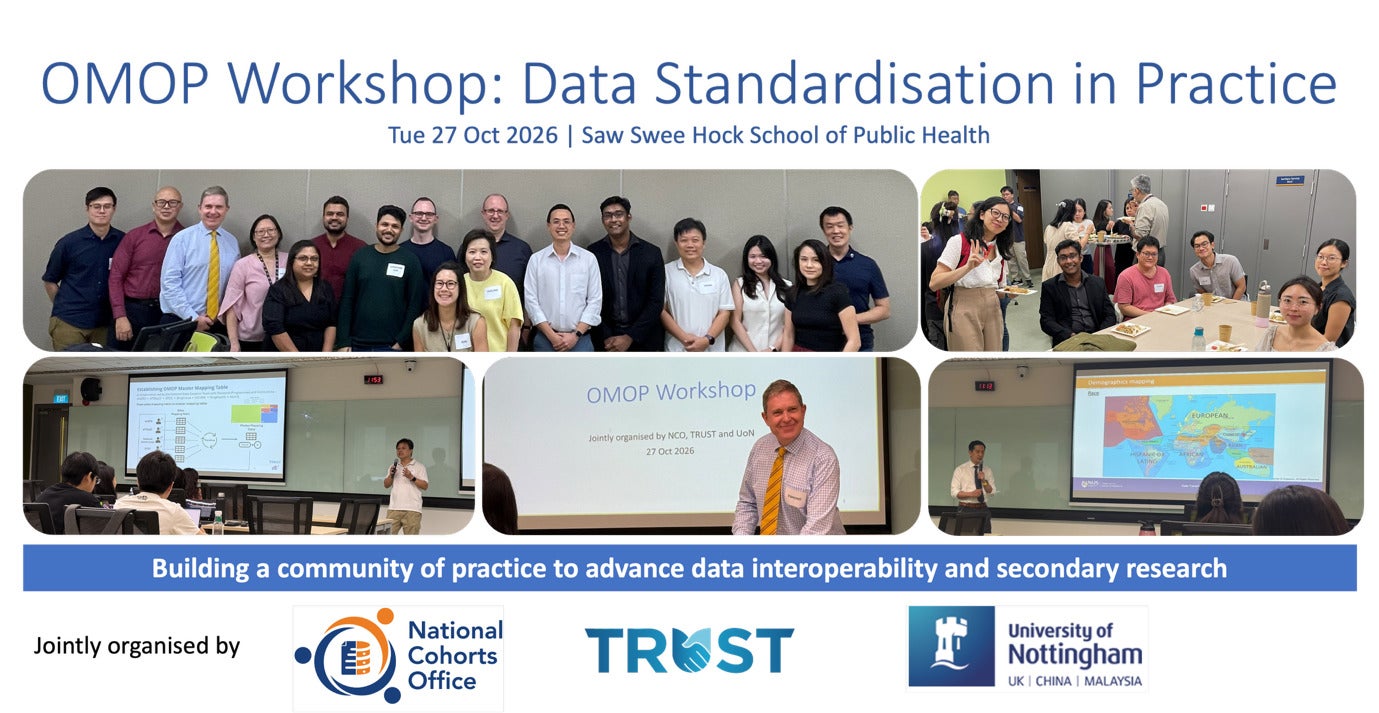
On 27 October 2026, the National Cohorts Office (NCO), TRUST and the University of Nottingham (UoN), successfully organised a one-day Observational Medical Outcomes Partnership (OMOP) workshop at the Saw Swee Hock School of Public Health, National University of Singapore (NUS). The workshop brought together over 70 researchers, clinicians and data professionals to explore how OMOP can support interoperability and facilitate cross-institutional research. Through expert presentations, real-world case studies and hands-on activities, participants gained insights into the practical applications, challenges and opportunities associated with implementing the OMOP Common Data Model (CDM).
A/Prof Sim Xueling, Director of NCO, opened the workshop by highlighting the role of OMOP in standardising healthcare data to facilitate analysis across hospitals, institutions and datasets. As research datasets become increasingly diverse, existing common data models may not adequately capture the breadth and complexity of information collected, e.g., lifestyle behaviours, social determinants of health across life course that are specific to Singapore’s unique socio-culture and multi-ethnic context.
Dr Esmond Urwin, Digital Research Technologist for the NIHR Nottingham Biomedical Research Centre at UoN, led the workshop with an introduction to the Observational Health Data Sciences and Informatics (OHDSI) community. He emphasised the importance of data standardisation and controlled vocabularies in ensuring consistency and reducing ambiguity across healthcare datasets. He also highlighted that data mapping is an iterative process requiring continuous refinement, and the importance of preserving the granularity of original source data throughout the transformation process. Mr Tri Thien Nguyen, Software Engineer at UoN, introduced the University of Nottingham’s OMOP ecosystem, introducing tools such as Carrot and Lettuce that support data mapping and transformation.
A series of invited speakers shared their experiences and insights from mapping diverse healthcare and research datasets to OMOP. The first speaker Dr Ngiam Kee Yuan, an endocrine surgeon and Head, Division of Biomedical Informatics, Yong Loo Lin Medical School, NUS, highlighted the value of adopting OMOP to improve data interoperability and facilitate robust comparative analyses across healthcare institutions and geographical regions. As an example, he shared challenges of harmonising medication data stored across different electronical medical systems. Assistant Prof Theresia Mina, Lee Kong Chian School of Medicine Nanyang Technological University, shared insights from the Health for Life in Singapore (HELIOS) and SG100K cohort studies. She described the data harmonisation journey, from preparing data dictionaries and identifying suitable standard concepts to registering research variables in the Athena vocabulary repository. Dr Mukkesh Kumar, shared experiences from the Growing Up in Singapore Towards healthy Outcomes (GUSTO) cohort. He highlighted the labour-intensive nature of OMOP mapping and the importance of domain expert review to ensure the accuracy and appropriateness of the mapping. Finally, Dr Erwin Tantoso, Lead Research Officer, introduced the Singapore OMOP Master Mapping Table; a resource designed to facilitate the reuse of existing mappings, reduce duplication of effort and promote greater consistency across Singapore’s research datasets.
A key highlight of the workshop was the hands-on OMOP vocabulary mapping session facilitated by Dr Urwin. Participants gained practical experience in identifying appropriate standard concepts, navigating OMOP vocabularies and addressing common challenges in mapping research data. The session underscored the importance of human expertise and judgement in ensuring accurate concept selection and domain classification, particularly when dealing with complex or context-specific research variables.
The workshop concluded with a call to action from the National Data Curation Team (NDCT) for participants to actively engage with the OMOP Community of Practice and its technical working groups. By bridging international expertise with local implementation experiences, the workshop fostered knowledge exchange and laid the foundation for sustained collaboration towards a more harmonised, interoperable, and research-ready health data ecosystem in Singapore.