

Upcoming Events
October 2026
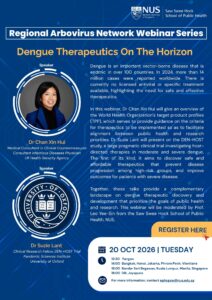
Dengue Therapeutics On The Horizon
In this webinar, Dr Suzie Lant will present on the DEN-HOST study, a large pragmatic clinical trial investigating host-directed therapies in moderate and severe dengue.
- Webinar
November 2026
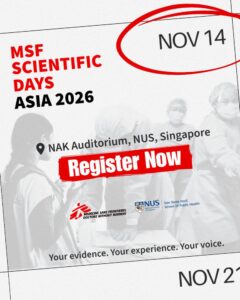
MSF Scientific Days – Asia 2026
MSF Scientific Days – Asia 2026 has evolved into a key regional platform for showcasing research, innovation, and field-based experiences across humanitarian and public health settings.
- Conference
- Global Health
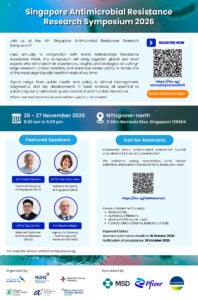
Singapore Antimicrobial Resistance Research Symposium
Held annually in conjunction with World Antimicrobial Resistance Awareness Week, this symposium will bring together global and local experts who will share their experiences, insights, and strategies on cutting-edge research, clinical practice, and evidence-based policy to tackle one of the most urgent public health threats of our time.
- Global Health
Past Events
August 2024
GHTLD – Small Countries, Global Impact: Shaping the Future of Global Health
In times like these, are small countries necessarily relegated to play a minor role in determining global health order, or is the voice of a country not determined by its geographical and population size, but instead by its ability to shape and lead global health developments? This inaugural Global Health Thought Leadership Dialogue convenes four international experts in global health to address this important issue during an era where the world struggles to arrive at genuine solutions to the world’s biggest problems.
- Public Health Thought Leadership Dialogue
May 2024
Staff Research Rounds – Prof Henk JMM Mutsaerts & Dr Jan Petr
Our work aims to understand how changes in non-invasive brain perfusion MRI can predict cognitive decline in our aging society and its relationship with cardiovascular risk factors. While current imaging techniques can only identify irreversible late-stage structural damage, perfusion MRI is sensitive to early-stage cerebrovascular changes that put patients at risk for cognitive decline. This talk will address the potential of brain perfusion MRI as early biomarker from recent population studies.
March 2024
Staff Research Rounds – Prof Miles Carroll
In this research round, Prof Miles Carroll will discuss the evidence of prior spillover of emerging viruses in these regions as well as the impact of environmental pressure, and other human factors, on the threat of future outbreaks.
- Research Round
February 2024
Staff Research Rounds – Smeetha Nair
You are cordially invited to the ON-SITE SPH Staff Research Round. We look forward to your attendance and we hope for an interesting discussion. Do hang around after the talk as light refreshments will be provided. We will also be having a Lucky Draw at the end of the session, so register yourself on-site and stand a chance to win a special prize! *Please note that we have changed to an on-site registration, so no prior registration is necessary!*
- Research Round
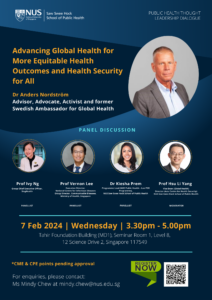
Advancing Global Health for More Equitable Health Outcomes and Health Security for All
Session Chair: Dr Anders Nordström Anders Nordström is the former Swedish Ambassador for Global Health. Medical doctor by background from the Karolinska Institute. Today advisor associated with the Karolinska Institute and the Stockholm School of Economics as well as principal senior fellow at the UN University International Institute for Global Health in Malaysia. He is currently a member of the Alliance for Health Systems Research’s board, the SUN-Lancet PRIME Commission, the International Vaccine Institute Global Advisory Group of Experts, and the Virchow Foundation for Global Health Council.
- Public Health Thought Leadership Dialogue
January 2024
Diabetic Foot: The Global State of Play
Every 1.2 seconds, someone in the world with diabetes develops a limb-threatening foot wound. Every 20 seconds, someone with a wound undergoes an amputation. Three- and five-year mortality amongst people with amputation exceeds all but the most aggressive cancers. With these data as a backdrop, we will review the current state of play regarding treatment of the diabetic foot and wounds in the developed and developing world. We will explore policy factors associated with the team approach to amputation prevention as well as tips for the structure of successful teams, both at SALSA and worldwide. The concept of the “Toe and Flow” philosophy of prevention will be explored. Subsequently, emphasis will be placed on specific successes and failures and perhaps a way forward toward extending ulcer-free-days in remission. We also explore the use of novel new technology merging consumer electronics with medical devices in an effort to prevent problems before they start. Further information regarding this lecture including video, manuscripts and blog available at: www.diabeticfootonline.com