


Health MovEMENT Building
Health movement building is not a single intervention but a cycle of empowerment – where communities continually learn, act, and evolve together toward greater wellbeing.
We were first commissioned to evaluate the Movements for Health (M4H) programme – an initiative by the Ministry of Health Office for Healthcare Transformation (MOHT) that set out to reimagine how health promotion and community programmes are designed. Unlike traditional top-down approaches, M4H places co-creation and participatory practice at its core. It invites communities, practitioners, and policymakers to work side by side – designing solutions with people, not for them. Building on this, we embarked on a systematic review to develop a practical checklist that defines what it means to build a health movement. This was complemented by a mixed-methods qualitative formative study, which helped us clarify the defining features of health movement building in real-world contexts.
What is a health movement?
Drawing on findings from our formative research [1], health movement building can be understood as a community-driven process that strengthens collective capability, deepens social participation, and nurtures shared ownership of health and wellbeing. It is guided by the MovEMENTs Checklist [2], a framework that identifies the core ingredients needed to grow and sustain a health movement.
The MovEMENTs Checklist consists of 6 Intermediate Results (i.e., key building blocks that show how a health movement grows and strengthens over time):
IR1 Move the community to be recruited and retained – Engaging people meaningfully from the start and sustaining their involvement over time;
IR2 Engage capacity and build capability – Equipping community members and volunteers with knowledge, skills, and confidence to take collective action;
IR3 Maintain emotional resonance and brand identity – Fostering a shared purpose, belonging, and motivation to keep the health movement alive;
IR4 Embed participatory approaches – Co-creating solutions through inclusive design, dialogue, and reflection;
IR5 Nurture network building and partnership – Strengthening relationships across community groups, organisations, and systems;
IR6 Team up to improve commissioning and funding structures – Advocating for supportive funding, commissioning, and policy environments that sustain local action.
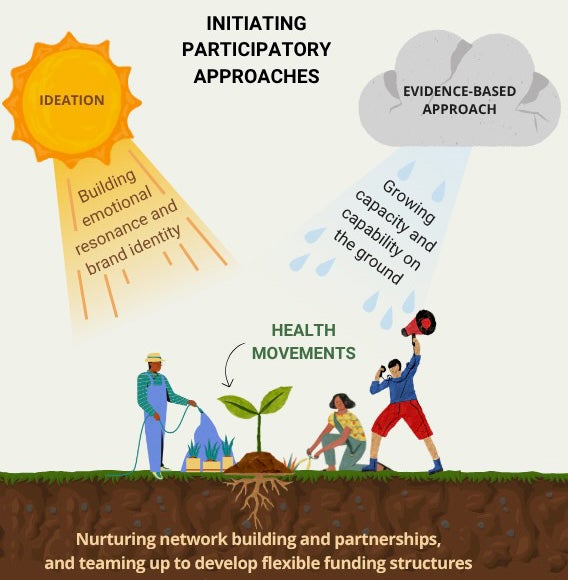
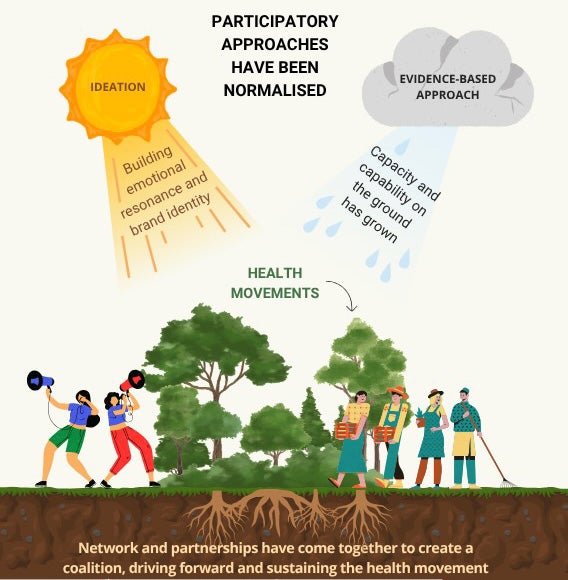
Visually, we have developed a diagram to illustrate this process – showing how building a health movement begins with seed funding and early collaboration, grows through participatory approaches (e.g., collective learning and participation), and matures into a sustained network for change.
1
Moving the Community
Health movement building begins with small, focused efforts supported by seed funding and participatory engagement.
Communities are mobilised around shared issues of concern, and early capacity-building activities help strengthen local capability and confidence. Through co-creation, ideas begin to take shape and align with lived experiences.
2
Health Movement Built
As participation becomes more embedded and networks strengthen, the health movement transitions into a sustained ecosystem.
Collaboration broadens across community groups and stakeholders, and evidence from practice informs ongoing adaptation. Over time, supportive structures, partnerships, and shared learning enable the health movement to maintain momentum and deliver lasting impact.
Read more here:

[1] Chan, F.J.H., Chan, A.Y., Zhuang, W.X. et al. Classifying strategies for building community health movements: a guide for implementers. BMC Public Health 25, 301 (2025). https://doi.org/10.1186/s12889-024-21046-y

[2] Chan AY, Chan FJH, Puah LJR, et al. Defining Health Movements and Health Needs Across the Life Course: A Qualitative Study. Health Expectations. Apr;28(2):e70228. (2025) doi: 10.1111/hex.70228