
These are some examples of the research projects and programmes that are being led by members of the domain. Please feel welcome to contact the relevant faculty members or visit the programme websites for more information.
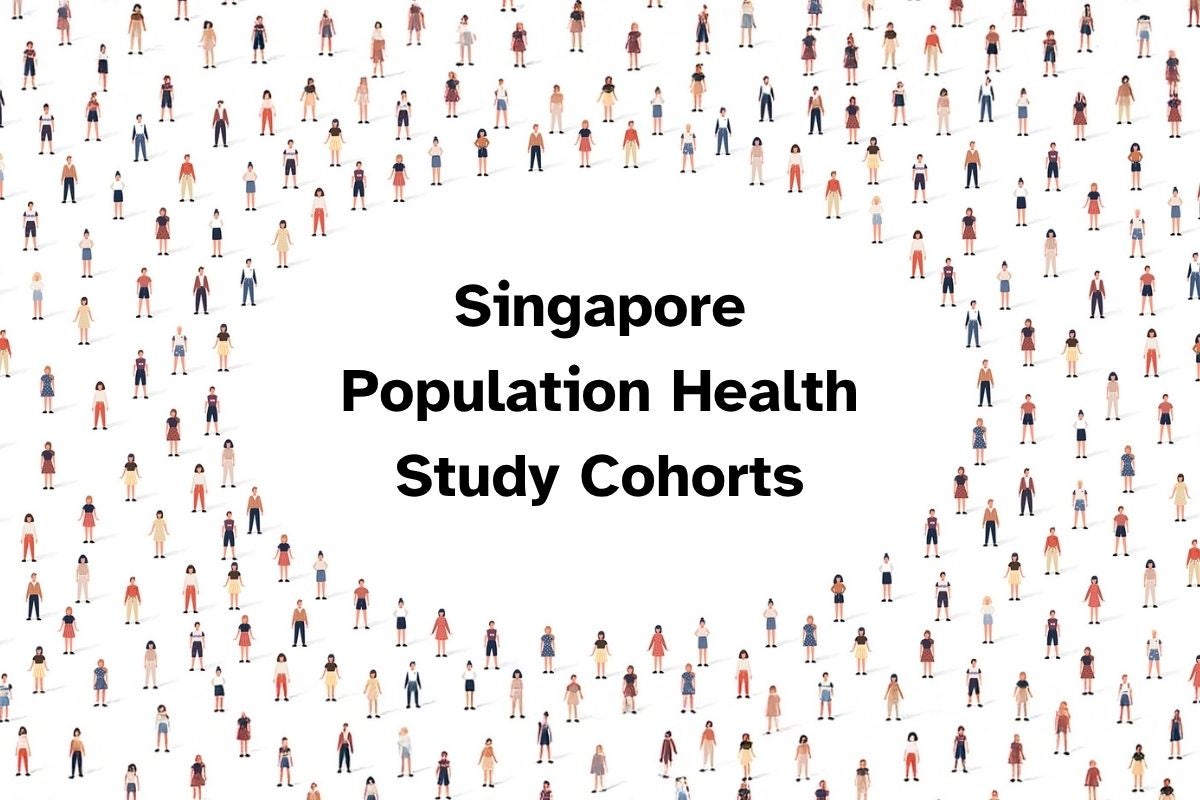
The Singapore Population Health Studies (SPHS) is a population-based health research initiative comprising seven independent cohorts spanning 20 years: the Multi-Ethnic Cohort (MEC1, MEC2 and MEC3), Diabetic Cohort (DC), Singapore Health Studies (SH2012 and SH2) and Community Healthy Study (CHS). Under the oversight of A/Prof Sim Xueling and a multidisciplinary scientific committee, SPHS investigates and collaborates with researchers to study the interactions between lifestyle, physiological, genetic and other ‘omics biomarkers and their impact on health and longevity. The Cohorts thus serve as a platform to monitor risk factors in the population and gain insight into determinants of health-related behaviours and understand disease etiology in urban Asian settings.
Recent publications
- Tan WY et al. Role of Brain Age Gap as a Mediator in the Relationship Between Cognitive Impairment Risk Factors and Cognition. Neurology. 2025 Jul 22;105(2):e213815.
- Yin et al. Interaction between polygenic risk score and reproductive factors in relation to lung cancer risk among Singaporean Chinese women. Public Health. 2025 Apr;241:115-121.
- Liang et al. Circulating proteomic profiles are associated with type 2 diabetes in Asian populations – a longitudinal study. J Clin Endocrinol Metab. 2025 Jan 22:dgaf045.
Professor David Paterson, as Director of ADVANCE-ID, has established the programme as a world leading clinical infectious diseases research hub. Over 100 hospitals in 20 Asian countries are now involved. ADVANCE-ID has enrolled over 10,000 patients in studies of hospital-acquired infections due to bacteria with antimicrobial resistance (AMR). ADVANCE-ID via SSHSPH has established a memorandum of understanding with comparable clinical trial networks in Europe and the United States in order to facilitate global reach for the programme. Professor Paterson and his team actively mentor junior faculty members in innovative clinical trial design and the epidemiology of AMR, fostering a new generation of researchers in the field.
Recent publications
- Jackson, H., Shou, Y., Azad, N.A.B.M. et al. A comparison of frequentist and Bayesian approaches to the Personalised Randomised Controlled Trial (PRACTical)—design and analysis considerations. BMC Med Res Methodol 25, 149 (2025)
- Hope, W., Nambiar, S., O’Brien, S. et al. Combining antibiotics to tackle antimicrobial resistance. Nat Microbiol 10, 813–816 (2025). https://doi.org/10.1038/s41564-025-01969-x
- Nguyen, A.T.K., V.K. Phuong Linh, D.T. Huong et al. Real-time investigation of a Burkholderia enocepacia bacteraemia outbreak in a Vietnamese intensive care unit. Journal of Hospital Infection, Volume 161, 74 – 82.


The Climate, Environment and Health programme is a research programme leveraging cross-disciplinary expertise to understand and evaluate the health risks associated with climate and other environmental changes. Under the leadership for A/Prof Yann Boucher and Dr Kimberly Fornace, the programme uses data-driven methods and technologies to monitor the impacts of environmental change on health and identify solutions to protect human and ecosystem health.
Southeast Asia is one of the most vulnerable regions in the world to climate change, with severe health impacts projected. The School sees a need to bridge the gap between climate science, environmental science, and health. Our vision is to create an interdisciplinary research program that strengthens our ties with environmental science groups and fosters collaboration within Singapore and the broader Southeast Asian region. Our research spans environmental change and infectious disease dynamics, air pollution, the built environment, nutrition and sustainable food systems, and machine learning methods for health and environmental data.
UHS-SPH Integrated Research Programme
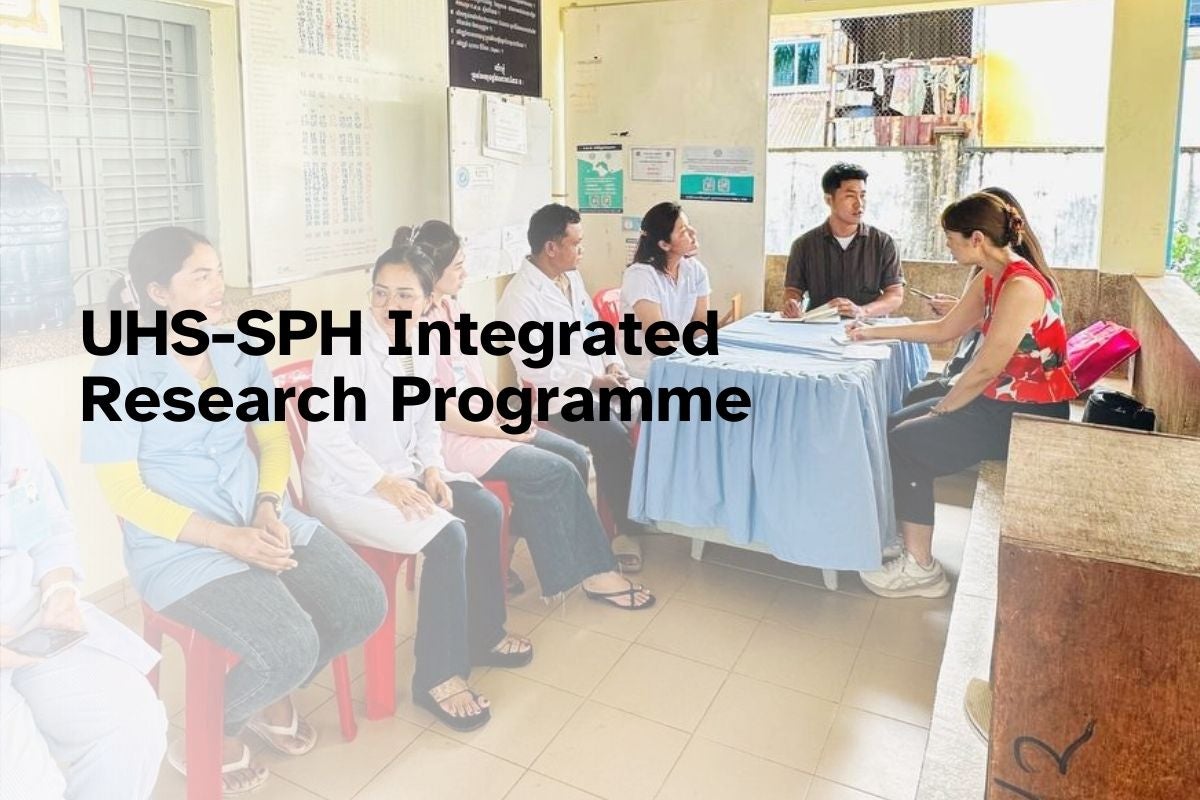
The NUS Cambodia Programme, launched in 2014 and led by A/Prof Siyan Yi, is a landmark collaboration between SSHSPH and multiple public health partners in Cambodia. Its first phase (2014–2019) focused on addressing critical health challenges such as tuberculosis (TB) and antimicrobial resistance and stewardship (AMR/AMS), while building sustainable public health research capacity in Cambodia and the wider Southeast Asian region. In its second phase (2019–2025), the programme expanded its scope to cover a broader spectrum of priorities, including maternal and child health, infectious diseases such as HIV/AIDS, TB, AMR/AMS, infection prevention and control, and non-communicable diseases, with particular attention to diabetes, hypertension, and mental health among people living with HIV and TB.
Looking ahead, the third phase (2026–2030) aims to strengthen collaborations with key government ministries, notably with the Ministry of Health on policy development, implementation, and evaluation to reinforce health system resilience. It will also engage with the Ministry of Economy and Finance to address health financing, social protection, health technology assessment, and universal health coverage. Additionally, partnerships with the Ministry of Education, Youth, and Sports will support the rollout of comprehensive school health programmes to promote youth well-being and long-term public health gains.
Recent publications highlighting the programme’s main research areas
- Yam ELY, Chhoun P, Tian Z, Nagashima-Hayashi M, Zahari M, Tuot S, et al. Cost-effectiveness analysis of a community-based model for delivery of antiretroviral therapy among stable people living with HIV in Cambodia. J Int AIDS Soc. 2025 Jul;28 Suppl 3(Suppl 3):e26476.
- Saing CH, Ung M, Suy S, Oy S, Dary C, Yam ELY, et al. i-MoMCARE – Innovative Mobile Technology for Maternal and Child Health Care in Cambodia: study protocol of a cluster randomized controlled trial. Trials. 2023; 24(1):692.
- Kikuchi K, Tuot S, Yasuoka J, Murayama M, Huot C, Yi S. Impact of oral intervention on the oral and overall health of children living with HIV in Cambodia: a randomized controlled trial. BMC Med. 2023;21(1):162.
- Teo AKJ, Morishita F, Prem K, Eng S, An Y, Yi S. Where are the missing people affected by tuberculosis? A program review of patient-pathway and cascade of care to optimize tuberculosis case-finding, treatment, and prevention in Cambodia. BMJ Global Health. 2023;8(3):e010994.

Generative AI for enhancing teaching of epidemiology and biostatistics
Dr Salome Rebello leads a team that aims to advance public health and epidemiology education by examining how students interact with generative artificial intelligence (AI) and by designing innovative evidence-based strategies to integrate generative AI effectively into learning.
The team’s first pilot study explores graduate public health students’ views on generative AI tools; examining their self-efficacy, use patterns, perceptions of benefits and risks, and preferred approaches for curriculum integration. Insights from this work will guide the design of curricula that prepare graduates to use generative AI responsibly in public health practice.
Their second study, in collaboration with NUS-AICET, uses generative AI to address longstanding challenges in teaching epidemiology and biostatistics to undergraduate healthcare students. The team is developing a learning aide to help students build confidence and connect data literacy skills to future professional practice. The prototype uses retrieval-augmented generation (RAG) and applies well-established pedagogical strategies such as scaffolding, scenario-based learning, quizzing, and reflection prompting to promote skill mastery. While initially designed for tutor support, once tested and refined, they hope to make this aide student-facing.
The team comprises Dr Salome Rebello, Ms Claire Tan, Dr Jasper Tromp, A/Prof Mary Chong, A/Prof Andre Muller, Prof Alec Morton and A/Prof Liow Chee Hsiang.