
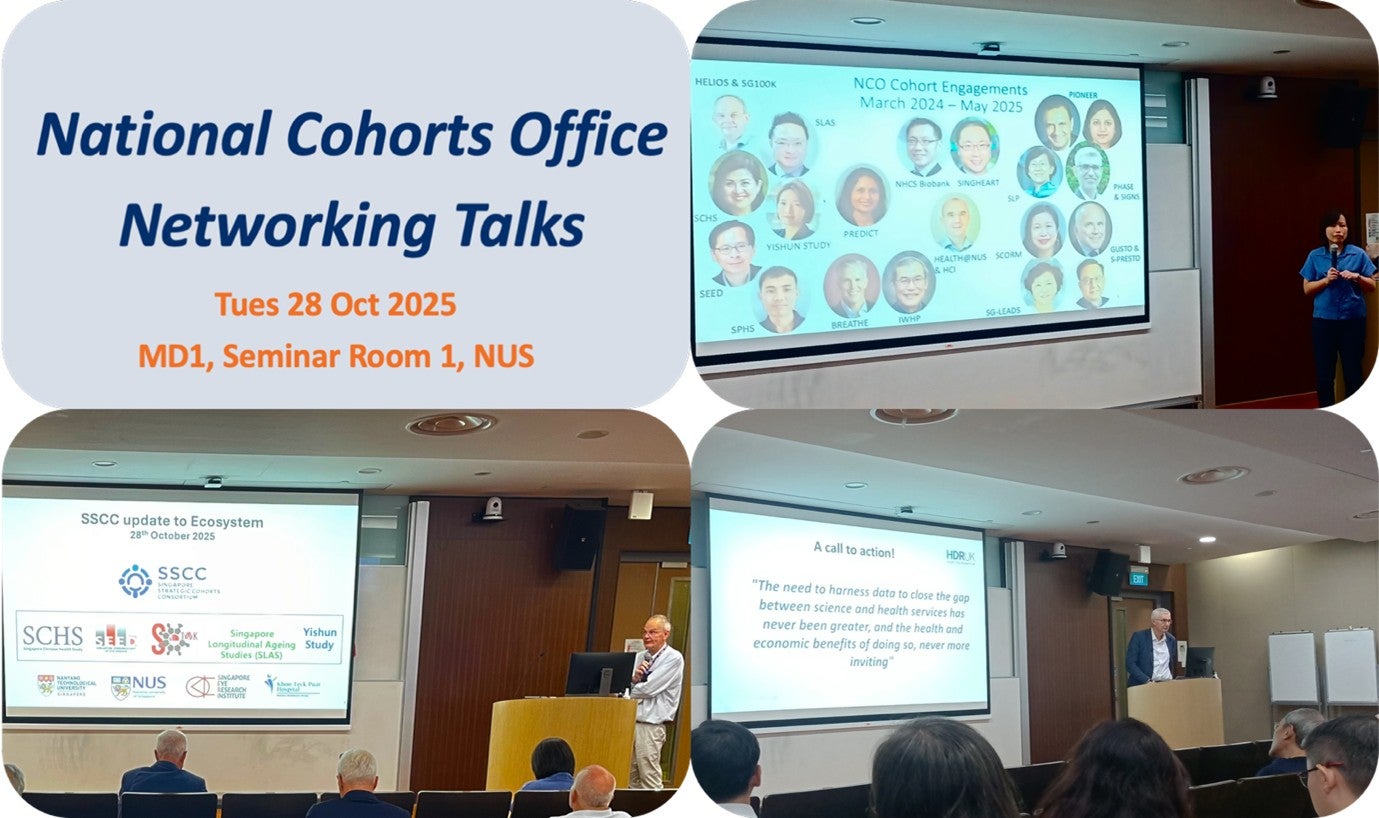
On 28 October 2025, the National Cohorts Office (NCO) hosted a networking event bringing together cohorts and their teams in Singapore. Also in attendance were members of the NCO’s Scientific Advisory Board – Professor Andrew Morris, Director of Health Data Research UK; Dr Joe McNamara, former Head of Cohort Strategy, UK Medical Research Council; and Professor Per Hall, Department of Medical Epidemiology and Biostatistics, Karolinska Institutet.
The event began with a networking lunch, followed by a keynote lecture from Professor Morris and a presentation by the Singapore Strategic Cohorts Consortium (SSCC). SSCC is a collaboration of four major population cohorts (Singapore Chinese Health Study (SCHS), Singapore Epidemiology of Eye Diseases (SEED), Singapore Longitudinal Ageing Studies/ Yishun Study (SLAS/YS) and SG100K) working to integrate data and expertise into a unified research resource of more than 160,000 participants.
In his talk, Professor Morris highlighted the opportunity to treat health data as national infrastructure capable of transforming healthcare, research, and productivity amid global pressures from ageing populations, rising healthcare demand, and diminishing workforce capacity. He underscored that advances in AI and medical science depend on large-scale, high-quality, responsibly governed data, and that countries with strong public health data systems such as the UK and Singapore have a significant advantage in driving future innovation. Professor Morris also described the UK’s investment in a trusted, secure, and interoperable data ecosystem through HDR UK, which fosters national and international collaborations across academia, healthcare, industry and charity while maintaining public trust through robust governance and transparency.
SSCC followed with a presentation on the consortium’s progress in establishing governance frameworks, harmonizing diverse datasets, developing a trusted research environment for secure data access, and launching demonstration projects that expand molecular, clinical, and imaging capabilities. Key achievements include building shared data dictionaries, onboarding imaging and omics data, standardizing clinical chemistry assays, enhancing genotyping through imputation and sequencing, and applying AI-driven analyses to DXA images. The consortium is actively promoting coordinated, multi-institutional collaboration and encourages other population cohorts interested in partnering or sharing knowledge to get in touch.
Catch the session via Youtube!