News

The-shifting-sex-industry-in-Singapore-and-the-need-for-better-screening-for-sex-workers

The shifting sex industry in Singapore and the need for better screening for sex workers

Sex work in Singapore has shifted from brothels to online, private and freelance spaces, making it harder for existing public health measures built around regulated venues to reach many workers.

To address these gaps, public health efforts need to extend beyond brothels and provide support that reflects the workers’ real needs, including mental health, safer work guidance and broader sexual and reproductive health support.

Hear from Asst Prof Rayner Tan as he highlights how Singapore’s public health approach can evolve to meet the realities of today’s sex work landscape.

Photo credit: The Straits Times

The shifting sex industry in Singapore and the need for better screening for sex workers Read More »

Experts-New-rider-insurance-rules-will-benefit-consumers-and-may-lower-medical-costs-and-premiums

Experts: New rider insurance rules will benefit consumers and may lower medical costs and premiums

Under new rules taking effect on 1 April 2026, insurers will no longer be allowed to offer riders that fully cover the government-mandated deductible. Patients will therefore shoulder part of their medical bills, even with a rider, a shift aimed at reducing overuse and keeping premiums sustainable.

Experts: New rider insurance rules will benefit consumers and may lower medical costs and premiums Read More »

NIPH-Study-Visit-at-SSHSPH-1

NIPH Study Visit at SSHSPH

From 12 to 14 November 2025, the Saw Swee Hock School of Public Health (SSHSPH) welcomed representatives from the National Institute of Public Health (NIPH), Cambodia, for a series of engaging and productive dialogues. Led by the Director of NIPH His Excellency Professor Chhea Chhorvann, the visit marked a significant step towards strengthening the partnership and collaboration between NIPH and SSHSPH, fostering the MOU recently signed in April between our institutions.

Postgraduate programmes in public health
The delegation from NIPH engaged in insightful discussions with representatives from SSHSPH Education Office where Dr. Te Vannarath, Head of the School of Public Health (NIPH), shared about the postgraduate programmes offered at NIPH. Representatives from the two institutions shared insights and lessons learnt about designing postgraduate programmes and developing public health professionals; both institutions agreed to explore opportunities to collaboratively support PhD students.

Digital transformation for institutional management systems
After listening to Associate Professor Liow Chee Hsiang, Vice Dean (Education), share about institutional management systems at SSHSPH, the NIPH team shared their visions for digital transformation of their academic and administrative management systems to support research at the institutional level. Afterwards, the team met with Assistant Professor Swapnil Mishra, joint appointment at SSHSPH and Institute of Data Science, Department of Statistics and Data Science to explore research collaborations and capacity-building activities in data analytics and data science.

On 14 November, the NIPH team visited the National University Health System (NUHS) campus where the NUHS team led by Dr. Ling Zheng Jye, Chief Medical Informatics Officer, shared their experience in the digital transformation of the hospital management systems and health analytics.

The NIPH team also met with Associate Professor Danny Poo, Founding Director of the Centre for Health Informatics, NUS, to gather insights and explore possible collaboration in setting up postgraduate programme in health informatics at NIPH.

Research collaboration and capacity-building
Potential research collaborations were discussed in the meeting with Associate Professor Müller-Riemenschneider Falk, Vice Dean (Research), and Associate Professor Kavita Venkataraman, joint appointment at SSHSPH and NUS Yong Loo Lin School of Medicine.

The NIPH team also met with Dr. Priya Balasubramaniam, Director – Strategy, External Collaborations and Growth to learn about the Leadership in Antibiotic Discovery and Development (LEAD) Programme – a peer-to-peer exchange fellowships on AMR stewardship and open science drug discovery.

The NIPH, through its School of Public Health, is committed to advancing education, research, and innovation to strengthen Cambodia’s public health system. We are excited to continue building strong partnership with NIPH and looking forward to transforming the ideas from this visit into reality!

NIPH Study Visit at SSHSPH Read More »

Singapore’s-silent-crisis-Is-grandpa-eating-well-and-enough

Singapore’s silent crisis: Is grandpa eating well and enough?

We often celebrate Singapore for its vibrant food culture, yet many older adults continue to face hidden malnutrition behind closed doors. Beyond being a medical issue with serious consequences, malnutrition reflects deeper, interconnected challenges — financial pressures, social isolation, functional limitations and cultural habits that shape how seniors eat. These everyday realities often go unseen.

Hear from Dean, Prof Teo Yik Ying, as he explains why malnutrition among older adults is on the rise and why addressing it must become a core part of Singapore’s national health strategy.

Photo credit: The Straits Times

Singapore’s silent crisis: Is grandpa eating well and enough? Read More »

The-antibiotics-crisis-isn’t-the-fault-of-science – it’s-market-failure

The antibiotics crisis isn’t the fault of science – it’s market failure

The WHO has warned of rising drug-resistant infections, and Singapore has updated its national action plan in response. Yet antimicrobial resistance (AMR) continues to grow worldwide, not because science has stalled, but because the commercial model for antibiotic development has collapsed. As pharmaceutical companies shift toward more profitable chronic disease drugs, the global pipeline for new antibiotics is shrinking.

The antibiotics crisis isn’t the fault of science – it’s market failure Read More »

Call for Abstracts: Australasian Mathematical Psychology Conference 2026

This year’s theme — Applying Mathematical and Quantitative Psychology to Real-World Complex Problems — brings together researchers exploring the intersections of data, cognition, and human behaviour.

Submit your abstract by 26 November 2025 and join leading scholars, including Prof Roger Ratcliff from The Ohio State University and Prof Irini Moustaki from The London School of Economics and Political Science, for three days of insightful sharing in Singapore.

📅 23–25 February 2026 | 📍 Shaw Foundation Alumni House, NUS

👉 Submission and Registration: https://ampc2026.com/

Call for Abstracts: Australasian Mathematical Psychology Conference 2026 Read More »

ASEF-1

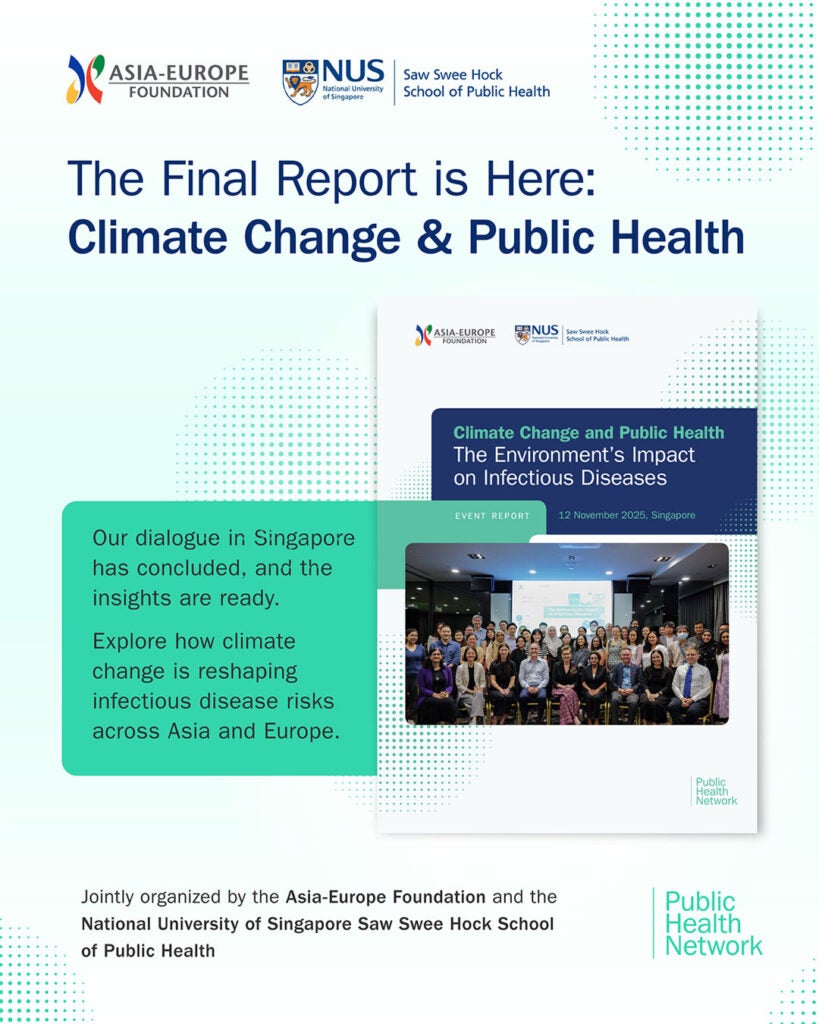
ASEF-SSHSPH Climate Change and Public Health Dialogue 2025

Thank you to everyone who joined us for “Climate Change and Public Health – the Environment’s Impact on Infectious Diseases” on 12 November at Park Avenue Rochester Hotel. Together, we:

• Raised awareness of climate-driven infectious disease risks across Asia and Europe
• Fostered cross-regional dialogue to compare vulnerabilities and adaptation strategies
• Bridged science and policy with evidence-based insights and practical approaches
• Examined strategic responses for resilient public health systems
• Built networks among researchers, policymakers, and practitioners

Our appreciation to Ambassador Beata Stoczyńska (ASEF), Mr Hotta Toru (Embassy of Japan in Singapore), and our expert panel: Prof Fredolin Tangang (Universiti Brunei Darussalam), Ms Sasha Mosky (European Environment Agency), Dr Chang Chia-Chen (National University of Singapore), and Dr Thilaka Chinnayah (WHO Regional Office for the Western Pacific), moderated by Associate Prof Yann Boucher (NUS Saw Swee Hock School of Public Health).

This was ASEF’s second collaborative event with NUS Saw Swee Hock School of Public Health, building on last year’s health security–focused programme. Thank you for helping us deepen this vital climate–health conversation.

ASEF-SSHSPH Climate Change and Public Health Dialogue 2025 Read More »

Designated-Workplace-Doctors-(DWD)-Conference-2025-1

Designated Workplace Doctors (DWD) Conference 2025

The Occupational Health Education & Research Unit (OHERU) organised the Designated Workplace Doctors (DWD) Conference 2025 on 8 Nov 2025.

Now in its second year, this one-day programme brought together DWDs and interested occupational safety and health professionals for refreshers on essential practice topics and updates on evolving challenges in occupational medicine.

Highlights included workshops on clinical examinations for statutory medical examinations, engaging talks by Occupational Medicine Specialists from our public hospitals, and insightful sessions and updates from the Ministry of Manpower. OHERU also welcomed vendor displays by Uvex, Ansell, and 3M, which showcased a range of personal protective equipment (PPE) and practical guidance on selecting appropriate PPE.

Thank you to all speakers, partners, and participants for a strong showing! OHERU look forward to building on this momentum in 2026.

Designated Workplace Doctors (DWD) Conference 2025 Read More »

ADVANCE-ID-workshop-in-London-1

‘There are no borders for AMR action’: Multisectoral insights from the Framing JUST solutions for access to treatment against AMR workshop

On November 4th at the British Academy in London, ADVANCE-ID welcomed a unique gathering of global experts in antibiotic access. With representatives from pharmaceutical development and manufacturing, international drug regulators, law and policy, healthcare professionals, global health actors, NGOs and patient advocates, participants shared their experiences working in antibiotic access and highlighted urgent challenges and priorities in their field.

“There are no borders for AMR action.”

The session attendees heard talks from clinicians and pharmacists on their experience accessing novel antibiotics and diagnostics in their hospitals. From regulators and NGOs, we learned about past and ongoing programs to facilitate equitable access to antibiotics, the challenges faced, and the lessons learned. We also heard insights from funders and pharmaceutical manufacturers on the financial pitfalls of antibiotic development and the barriers to market access in LMICs. Most strikingly, we had the opportunity to hear from patient advocates on their experience trying to access unregistered antibiotics in an LMIC healthcare system, demonstrating the painful uncertainty and human cost of inequitable antibiotic access.

“What does it mean for products to be designed with LMICs in mind?”

Particularly insightful were the panel discussions with perspectives from regulators, funders, pharmaceutical industry representatives, and academic researchers. The first discussion, on identifying bottlenecks in the AMR pipelines, lack of regulatory reliance, loss of research and development knowledge in industry, and the difficulty of incentivising market entry in small countries. The second discussion, on identifying key stakeholders and opportunities for action, illustrated the importance of considering LMIC contexts from Day One of product development, the need for coordinated leadership, and the necessity of unified efforts across sectors.

“If you had a magic wand, what would you change?”

Following these talks, we broke out into expert discussion groups with the goal of identifying specific barriers and solutions for each of the five pillars identified by the Roadmap to Access to Newer Antibiotics in Asia: 1) regulatory aspects and clinical trials, 2) patient advocacy and ethics 3) improve surveillance for data generation 4) commercialisation of drugs and procurement and 5) improved infrastructure in antibiotic stewardship, infection prevention and control and diagnostics which should be primary to new drug introduction.

We aim to synthesize and publish these invaluable expert insights on the Roadmap that can guide action on AMR access, highlighting the ways in which each stakeholder has a critical role to play and catalysing the step from discussion to action.

“Who can help me?”

There was a resoundingly clear takeaway from this workshop: AMR action must be multisectoral. By bringing together the key stakeholders from across domains, we hope to unite our efforts and identify opportunities for collaboration. As Dr. Mo Yin asked our participants to consider, “Think about one or two things that you can do. If you can’t do it on your own, look across the room and think, ‘who can help me?’

We leave this gathering with a renewed perspective and a unified purpose: to work within and across our domains to drive sustainable and equitable antibiotic access. Most importantly, we leave with new partnerships to pave the way forward together.

‘There are no borders for AMR action’: Multisectoral insights from the Framing JUST solutions for access to treatment against AMR workshop Read More »

Scroll to Top